


How a Pro Dispatcher Prevents Amazon Relay Driver and Vehicle Violation in 2026

The rules for surviving on the Amazon Relay network have fundamentally changed. Historically, maintaining acceptable FMCSA SMS scores over a two-year period kept your trucks moving. Today, passive compliance leads straight to the dreaded "Account Suspended" banner.
Amazon has completely re-engineered its eligibility protocols for 2026. Carriers now face highly aggressive, real-time safety violation rates alongside the newly implemented Driver Assignment Support (DAS) feature.
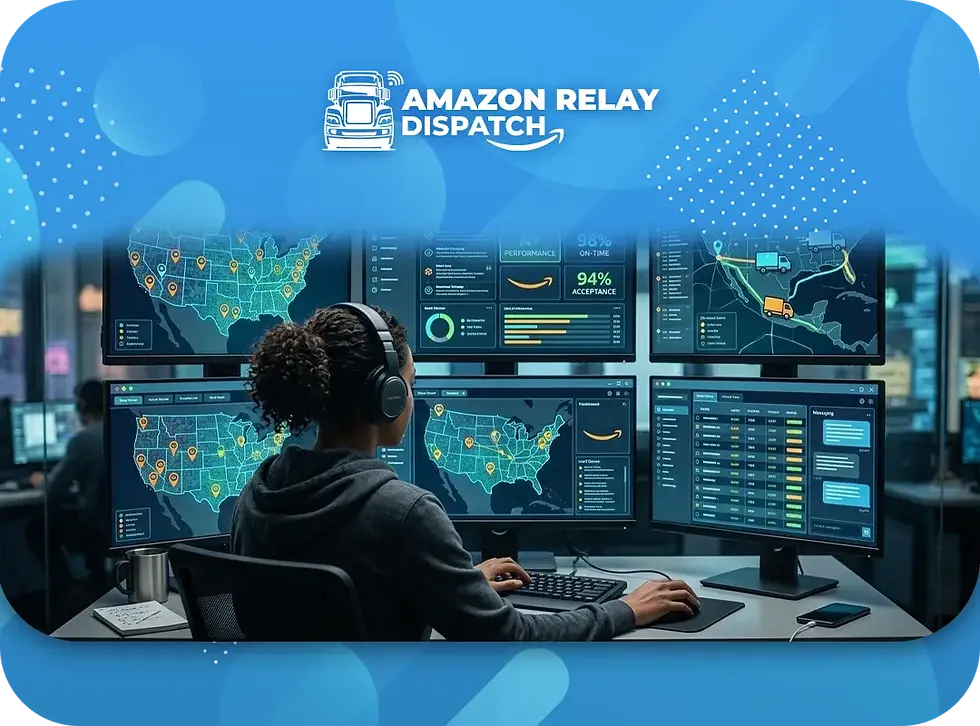
As seen in recent portal updates, the DAS algorithm actively monitors fatigue, automatically flagging drivers as "Ineligible" if their load history lacks adequate rest.
In this guide, we will break down these brutal new safety and scheduling metrics and reveal how partnering with a pro dispatcher is the ultimate strategy to prevent account suspensions and dominate the 2026 freight market.
Understanding the Two New Amazon Relay Safety Standards

The days of relying on a 24-month rolling average to dilute a bad inspection are over. To protect its massive digital freight network, Amazon has implemented a highly reactive safety matrix that isolates raw FMCSA roadside inspection data from the 12 months immediately preceding.
To maintain access to the Relay load board in 2026, motor carriers must now comply with two distinct, enforceable rates:
The Driver Violation Rate: Must be maintained at or below 35%.
The Vehicle Violation Rate: Must be maintained at or below 50%.
These are not arbitrary guidelines; they are hard-coded thresholds. Once your DOT number registers three or more inspections within a 12-month window, the algorithm activates.
If your fleet breaches the 35% driver or 50% vehicle limit, Amazon executes an immediate, uncompromising compliance hold. Your ability to bid on auctions, secure round-trip contracts, or access the spot board is instantly revoked.
The Brutal Math Behind the Amazon Relay Violation Rate Formula
To truly understand the danger of an Amazon Relay suspension, you must understand the math. The formula Amazon Relay uses to calculate both your driver and vehicle violation rates is heavily skewed to penalize fleets for acute safety threats.
Here is the exact formula: [Total Non-OOS Violations + (Out-of-Service Violations × 2)] ÷ Total Number of Inspections
In this system, a standard violation counts as 1 point. However, an Out-of-Service (OOS) violation is weighted doubly; it counts as 2 points.
Let’s look at how easily this math can destroy a small-to-medium enterprise (SME) trucking company. Imagine your fleet undergoes exactly four vehicle inspections over a 12-month period. Your drivers nail the first three inspections perfectly, zero violations. You feel confident.
But during the fourth inspection, a CVSA inspector finds a severely under-inflated tire (resulting in one OOS violation) and a cracked windshield (one non-OOS violation).
Let's plug that into the Amazon Relay formula:
The OOS tire violation equals 2 points.
The non-OOS windshield violation equals 1 point.
Your numerator is 3.
You divide that 3 by your total number of inspections (4).
Your Vehicle Violation Rate is 0.75, or 75%.
Despite having a 75% clean inspection track record for the entire year, that single bad inspection mathematically forces your fleet well above the 50% maximum allowable threshold.
The result? An immediate Amazon Relay suspension.
The Danger of OOS Violations: What Triggers Suspensions?

To survive the 2026 Amazon Relay safety standards, fleets must identify and eliminate the specific mechanical and behavioral failures that lead to Out-of-Service orders.
Because Amazon weighs these violations doubly, they are the fastest way to lose your freight access and trigger skyrocketing commercial auto liability insurance premiums.
Top Vehicle OOS Triggers:
Tires: Flat tires, audible air leaks, or tread depth below legal limits (FMCSA Code 393.75) carry a near-absolute 97.8% OOS rate.
Brakes: The dreaded "20% rule," where an inspector determines 20% of the service brakes are defective or out of adjustment, guarantees an OOS order.
Lighting: Burnt-out turn signals and inoperative stop lamps are mathematically devastating under the new rules.
Top Driver OOS Triggers:
Hours of Service (HOS): Falsified logbooks, missing ELD records, or driving beyond the 11-hour limit.
Licensing & Medical: Operating without a valid CDL or an expired DOT medical card.
Moving Violations: Speeding 6-10 MPH over the limit (often cited under 392.2) heavily inflates your 35% Driver Violation Rate limit.
How a Pro Dispatcher Prevents Amazon Relay Suspensions

An Amazon Relay suspension is rarely just a "driver problem"; it is almost always a systemic dispatch and operational failure. Passive dispatchers simply book loads and hope for the best.
A pro dispatcher, on the other hand, acts as a proactive compliance shield, engineering your daily operations to ensure bad equipment and fatigued drivers never hit the public highway.
Here is how elite dispatch management teams protect your Amazon Relay account:
1. Enforcing Unyielding Pre-Trip and Preventative Maintenance
The vast majority of vehicle-related OOS violations, especially tires and lights, are entirely visible before the tractor leaves your terminal.
Pro dispatchers enforce strict Standard Operating Procedures (SOPs) around Driver Vehicle Inspection Reports (DVIRs). If an ELD logs a pre-trip inspection in under five minutes, a pro dispatcher instantly flags it as "pencil-whipping."
Furthermore, elite dispatchers utilize a "Tag and Lock" protocol. If a driver reports an audible air leak or a bald tire, the dispatcher physically and digitally locks that asset out of the system.
The load is rescheduled, and the truck does not move until a certified mechanic clears it. Missing a single delivery appointment is vastly cheaper than losing your entire Amazon account over a blown tire.
2. Strategic Routing and HOS Management
Driver violations spike when dispatchers push operators beyond their legal Hours of Service. Pro dispatchers use advanced Transportation Management Systems (TMS) to algorithmically route trucks.
They factor in severe weather, Amazon distribution yard congestion during Peak/Prime Day events, and realistic transit times. By ensuring drivers have ample buffer time, the pressure to speed or falsify ELD logs completely vanishes, keeping your Driver Violation Rate safely below 35%.
3. "Denominator Dilution" and Roadside Inspection Mastery
Remember the mathematical formula? The only way to lower your violation percentage is to increase the denominator, your total number of inspections.
Pro dispatchers actively encourage drivers operating pristine, newly maintained equipment to politely request Level I or Level II roadside inspections at weigh stations.
A perfectly clean inspection adds a "zero" to your violation points but adds a "one" to your total inspection count. This "denominator dilution" effectively shields your percentage rate from the impact of future, unavoidable minor violations.
Clean trucks, highly organized compliance binders, and professional drivers are the ultimate tools for hacking the Amazon Relay algorithm.
4. Rapid Driver Coaching via the Behavioral Influence Framework
When a minor violation does occur, pro dispatchers do not wait for an end-of-the-month safety meeting. They utilize the "Soon, Certain, and Positive" coaching framework.
Within 24 hours of an FMCSA alert, the dispatcher engages the driver. They don't yell; they objectively connect the specific behavior (e.g., speeding) to the company's Amazon Relay Driver Violation Rate, explaining exactly how it jeopardizes the fleet's livelihood.
This documented coaching fixes bad habits instantly and provides vital legal cover.
Fixing an Amazon Relay Suspension: DataQs and POAs

What happens if you are already staring at the red "Account Suspended" banner? The remediation process requires a highly strategic, two-pronged approach. Because Amazon Relay does not have a "dispute" button for its math, you have to attack the problem at its source.
Cleansing Source Data via FMCSA DataQs
If your violation rate is artificially inflated by an inspector's mistake or a non-preventable accident, a pro dispatcher will immediately file an FMCSA DataQ challenge.
If you were cited for an inoperative tail light, but your maintenance logs and AI dashcam prove the light was working at the time of the stop, a heavily documented DataQ challenge will force the FMCSA to remove the violation.
Once the federal database updates, your Amazon Relay metrics will dynamically recalculate and lower.
Crafting a Winning Plan of Action (POA)
If the violations are legitimate, the only way back onto the load board is by submitting a highly structured Amazon Relay Plan of Action (POA). Do not use recycled internet templates; Amazon’s compliance teams reject them instantly.
A winning POA must contain three distinct sections:
Root Cause Analysis: Taking institutional ownership of the dispatch failure (e.g., "Our SOPs did not mandate enough time for proper tire inspections").
Corrective Actions: The immediate steps taken to neutralize the threat (e.g., "We terminated the non-compliant driver and grounded the defective asset").
Preventative Measures: The long-term structural changes implemented (e.g., "We have hired a pro dispatch service to monitor our ELD compliance and enforce daily DVIR reviews").
Protect Your Fleet: Partner with a Pro Dispatcher Today
The implementation of the 2026 Amazon Relay safety standards marks the end of the road for sloppy trucking operations. With Out-of-Service violations mathematically weighted to destroy your load board access, the margin for error is officially zero.
Do not wait for a random roadside inspection to dictate the future of your trucking company.
By partnering with a pro dispatcher, you are not just getting load-booking assistance; you are investing in an impenetrable compliance shield.

Keep your Driver Violation Rate below 35%, keep your Vehicle Violation Rate below 50%, and keep your trucks dominating the Amazon Relay load board.
Contact us today to learn how our expert dispatching and compliance management services can safeguard your revenue and scale your fleet.


Comments